64% of Americans Support Legal Paid Surrogacy, New YouGov Survey Finds

Nearly two-thirds of Americans believe paid surrogacy should be legal in the United States, according to a new YouGov survey. The findings also show that most Americans consider compensating a surrogate morally acceptable, although many remain uncertain about the country's current surrogacy laws.
The survey, conducted on November 13, 2026, among 5,152 U.S. adults, examined public attitudes toward paid surrogacy through four questions covering its legality, moral acceptability, current legal status, and whether respondents would consider hiring a surrogate themselves.
Nearly Two-Thirds of Americans Support Legal Paid Surrogacy
YouGov asked whether paid surrogacy, in which a woman receives compensation for carrying and delivering a baby for another person or couple, should be legal in the United States.
The results showed that 64% of Americans believe paid surrogacy should be legal, while just 11% believe it should be illegal. Another 24% said they were unsure.
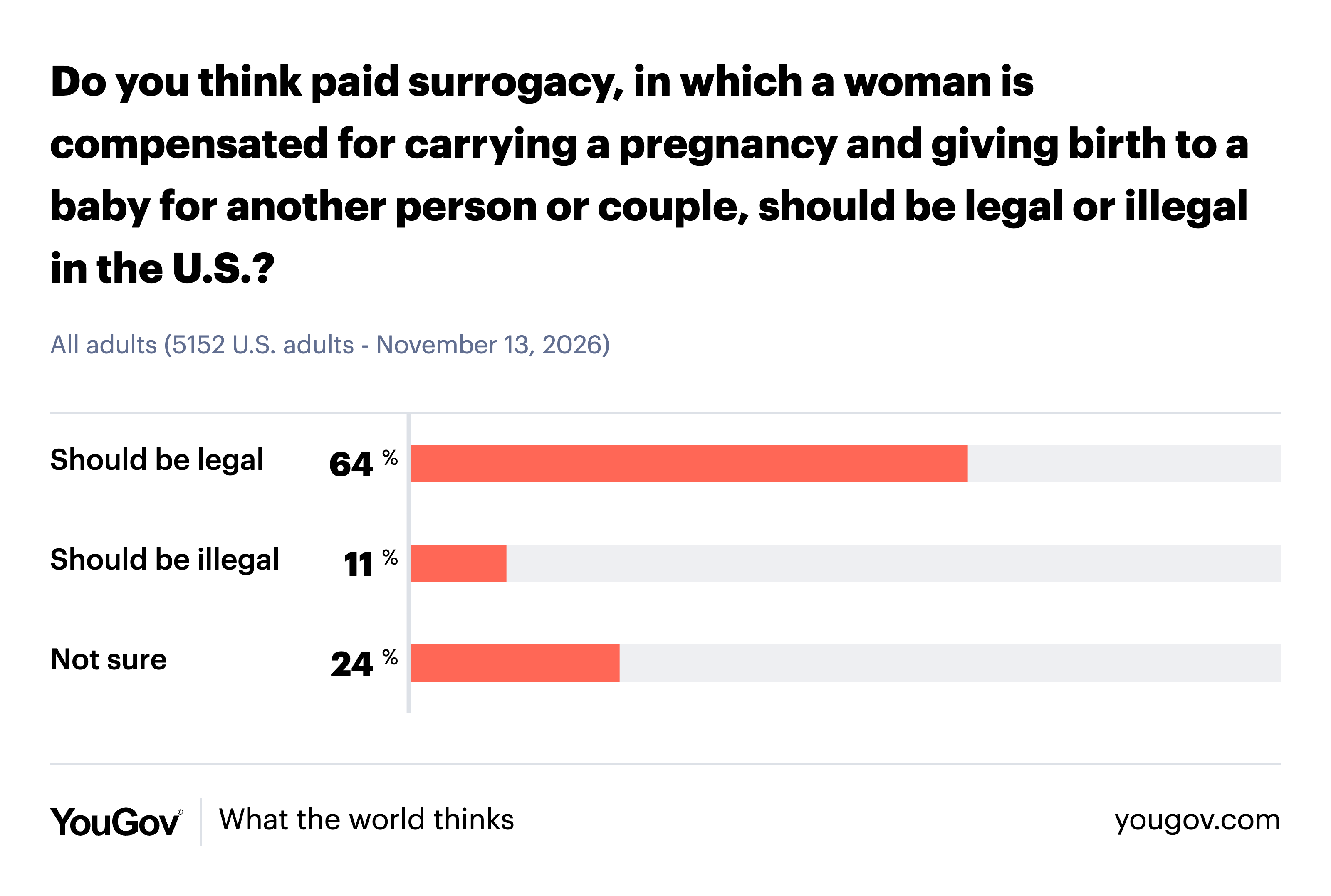
Support for legal paid surrogacy was nearly six times higher than opposition, representing a 53-percentage-point difference between the two groups.
However, nearly one-quarter of respondents were undecided, indicating that a substantial portion of the public has not expressed a clear position on whether compensated surrogacy should be permitted.
Most Americans Consider Paid Surrogacy Morally Acceptable
A separate question explored the ethical dimension of compensated surrogacy, asking whether it is morally acceptable for a person or couple to pay a woman to carry and give birth to a baby for them.
63% of respondents considered paid surrogacy morally acceptable, compared with 13% who considered it morally unacceptable. The remaining 24% were unsure.
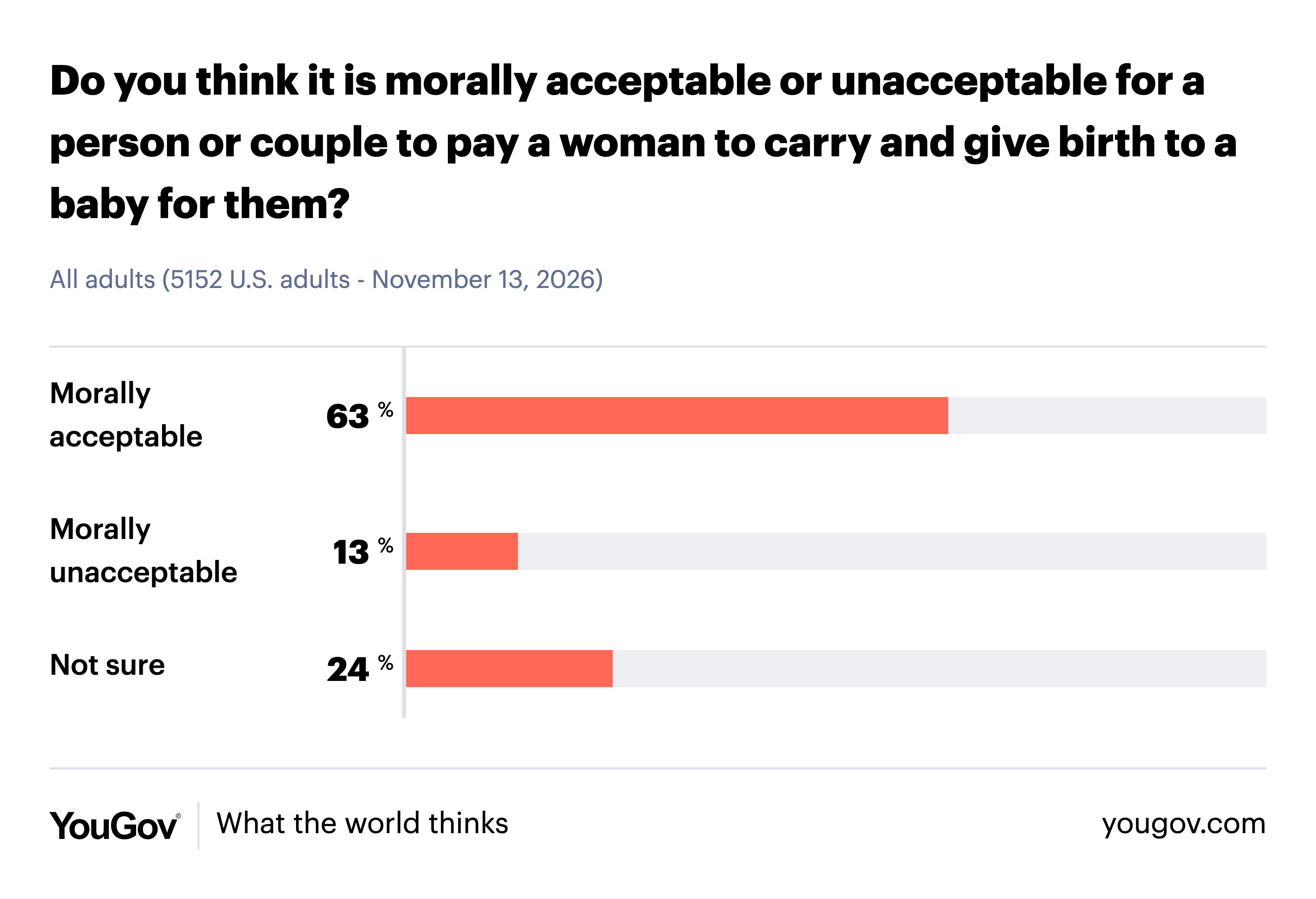
The results closely mirror Americans' views on legality, with only a one-percentage-point difference between those supporting legal paid surrogacy (64%) and those considering it morally acceptable (63%).
Although the survey does not establish whether the same individuals gave both answers, the findings show broadly similar levels of support across the two questions.
The results also highlight that a significant minority of Americans either oppose compensated surrogacy on moral grounds or remain undecided about its acceptability.
Many Americans Are Uncertain About Surrogacy Laws
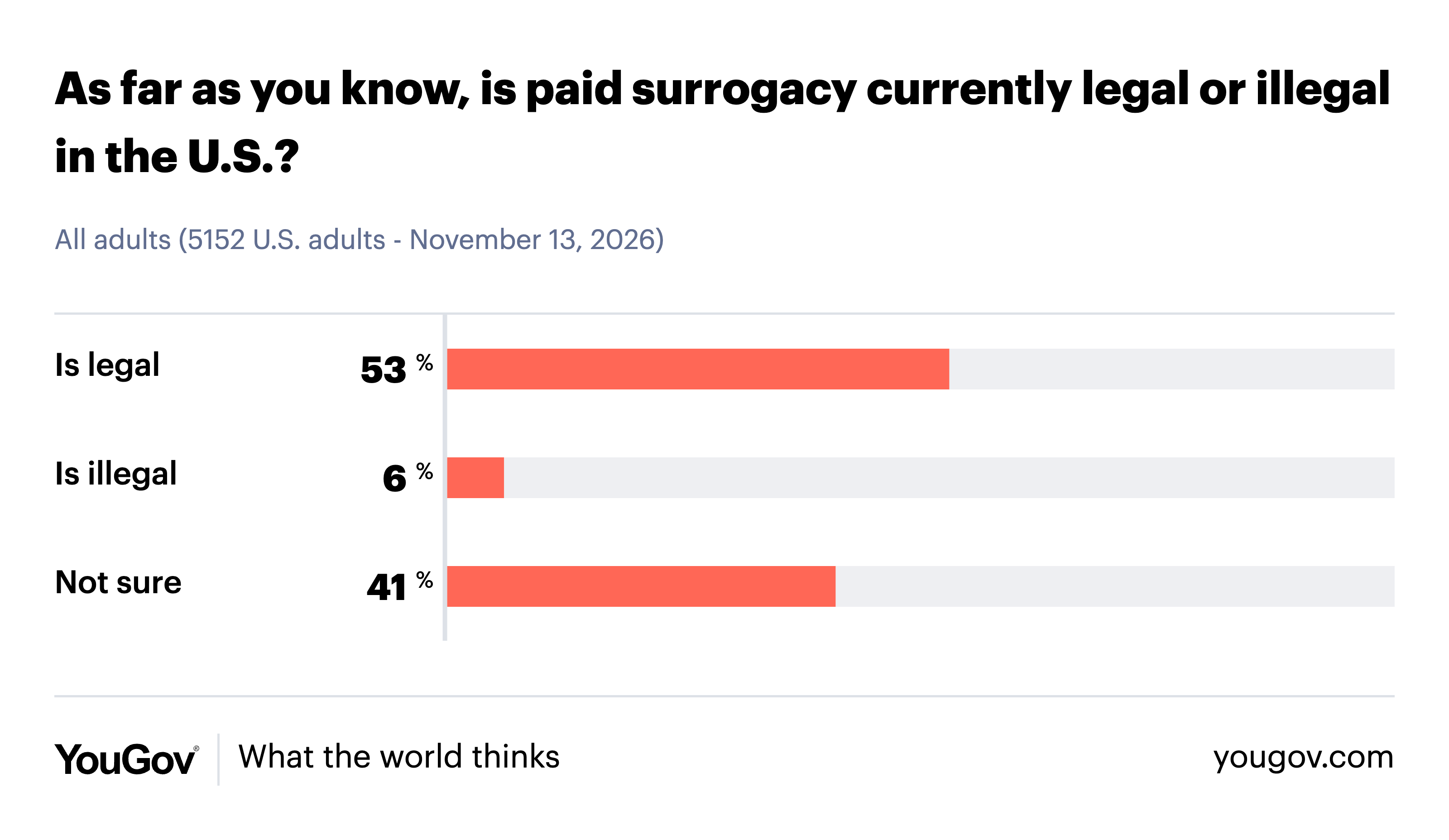
Despite majority support for paid surrogacy, the survey revealed considerable uncertainty about its current legal status in the United States.
When asked whether paid surrogacy is currently legal or illegal in the U.S., 53% of respondents believed it was legal, while 6% believed it was illegal. A substantial 41% said they were not sure.
The question is particularly relevant because the United States does not have a single, uniform federal legal framework governing surrogacy arrangements.
Instead, surrogacy laws vary by state. Some states expressly permit compensated gestational surrogacy, while others impose restrictions or do not provide a clear statutory framework. The enforceability of surrogacy agreements and procedures for establishing legal parentage can also differ.
According to the American Society for Reproductive Medicine (ASRM), gestational carrier arrangements are governed by state-specific laws, court decisions, and regulatory policies rather than an overarching federal statute.
This makes the question of whether paid surrogacy is legal in the U.S. difficult to answer with a simple yes or no.
The finding that 41% of Americans are unsure about its legal status underscores the complexity of the subject and the importance of accessible, state-specific legal information for people considering surrogacy.
Would Americans Consider Hiring a Surrogate Themselves?
The final question explored whether respondents would personally consider surrogacy under a hypothetical scenario in which they wanted a biological child but neither they nor their partner could carry a pregnancy.
The responses were more evenly divided than those concerning the legality or morality of paid surrogacy.
37% of respondents said they would be likely to consider hiring a surrogate, including 14% who said they would be very likely and 23% who said they would be somewhat likely.
Meanwhile, 40% indicated they would be unlikely to consider it, comprising 15% who were not very likely and 25% who were not at all likely. Another 23% were unsure.
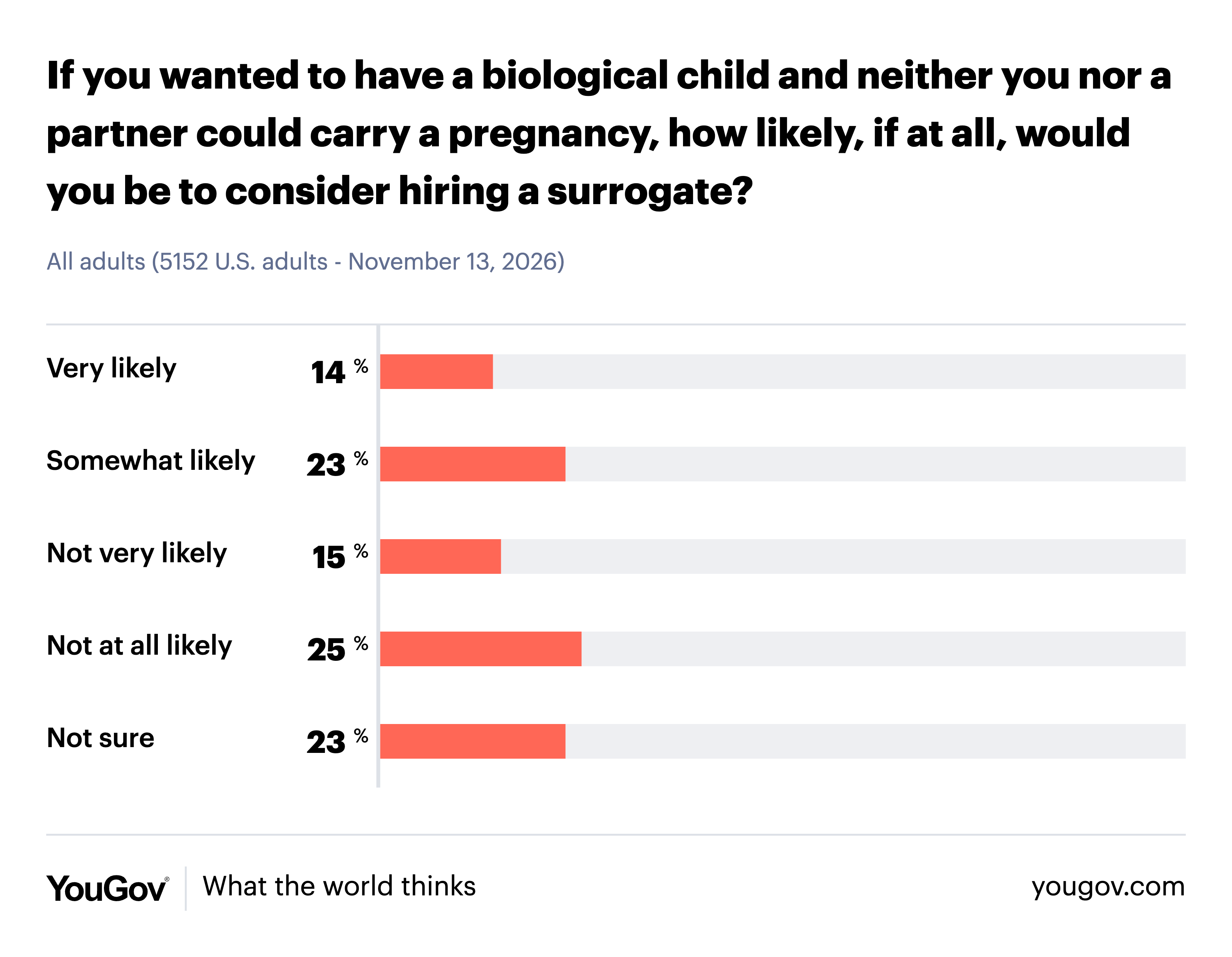
These findings reveal a distinction between supporting surrogacy as an option for others and considering it for oneself.
While nearly two-thirds of Americans support the legality of paid surrogacy, just over one-third said they would be likely to consider pursuing it under the circumstances described.
The results should not, however, be interpreted as a measure of actual demand for surrogacy services. Respondents were answering a hypothetical question, and the survey did not investigate the reasons behind their willingness or reluctance.
What the Findings Reveal About American Attitudes Toward Surrogacy
Taken together, the four YouGov questions provide a snapshot of public attitudes toward compensated surrogacy in the United States.
The findings show that majorities of Americans support allowing paid surrogacy and consider it morally acceptable. Opposition on both questions was considerably lower, although approximately one-quarter of respondents remained undecided.
At the same time, the results reveal two important distinctions.
First, public support for surrogacy does not necessarily translate into personal willingness to pursue it. While 64% support its legality, 37% said they would be likely to consider hiring a surrogate if they could not carry a pregnancy themselves.
Second, attitudes toward paid surrogacy appear more settled than knowledge of its legal status. While most respondents expressed a position on whether surrogacy should be legal, 41% were unable to say whether it currently is.
For intended parents, surrogates, and professionals working in the surrogacy industry, the findings highlight the importance of distinguishing public attitudes from legal realities.
The survey provides evidence of broad public acceptance of paid surrogacy, but it does not establish whether support has increased over time or how Americans feel about specific laws, compensation arrangements, or regulatory safeguards.
About the Survey
The findings are based on four questions included in YouGov's Daily Questions survey, conducted and published on November 13, 2026, among 5,152 U.S. adults.
The original results, including demographic breakdowns, are available on YouGov:
- Should paid surrogacy be legal or illegal in the U.S.?
- Is paid surrogacy currently legal or illegal in the U.S.?
- Is paying a surrogate morally acceptable or unacceptable?
- How likely would Americans be to consider hiring a surrogate?
Note: Percentages are rounded to whole numbers and may not total exactly 100%.